
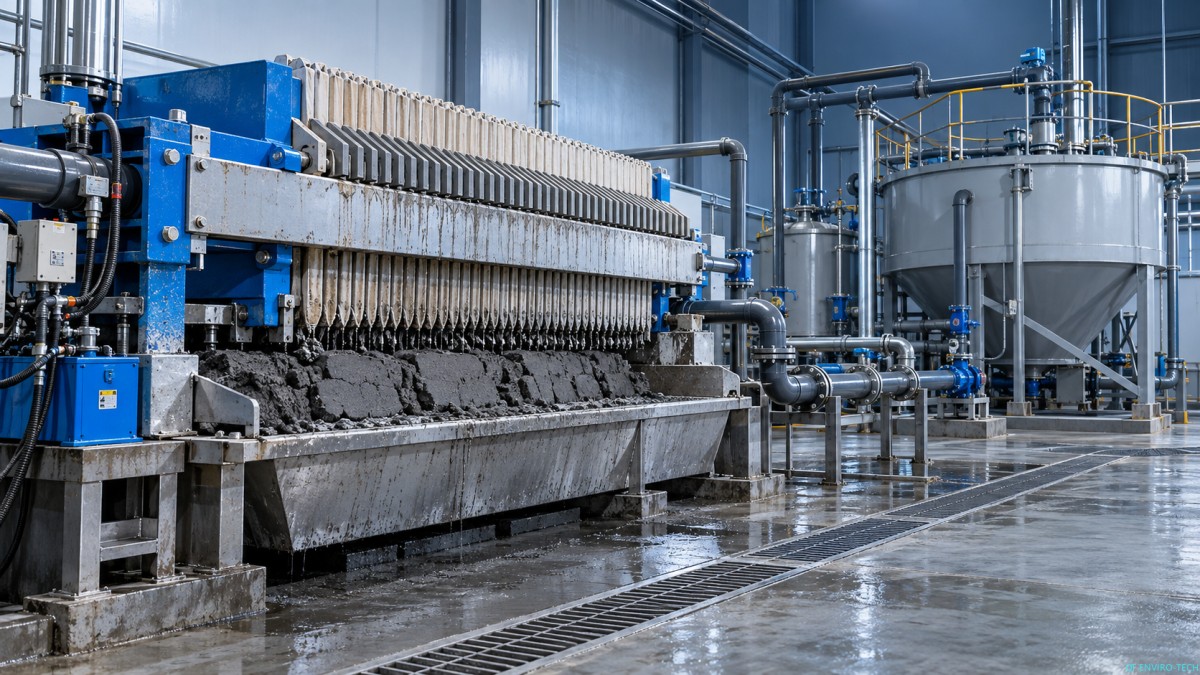
Sludge production in battery wastewater treatment depends on both the amount of material removed from the water and the chemicals used to remove it. A rise in wet sludge volume does not necessarily mean that more pollutants have entered the plant: it can also result from poorer settling, a higher chemical dose, or a wetter filter cake.The most useful distinction is between dry solids generated and wet sludge sent for disposal. Dry solids reflect the mass of precipitated contaminants, captured particles, chemical residues, and biomass where biological treatment is used. Wet sludge also includes water retained in the cake, which can dominate the weight and disposal cost.
Wastewater composition determines the starting load
Battery manufacturing wastewater is not a single, consistent stream. Depending on the products and production steps, it can contain nickel, cobalt, manganese, copper, aluminum, lithium, fluoride, suspended electrode materials, and organic compounds. Battery recycling streams can have a different composition again. The concentration and flow of each stream determine the daily pollutant load entering treatment.
Metal-bearing wastewater treated by chemical precipitation produces solids when dissolved metals are converted into less soluble compounds, such as metal hydroxides. More dissolved metal generally means more precipitated solids, but the relationship is not one-to-one by weight: the precipitate also contains material contributed by the treatment chemicals. Suspended particles already present in the influent add to the solids captured.
Fluoride removal can add a separate solids load. When calcium is used to precipitate fluoride, calcium fluoride forms, while competing reactions and excess calcium can produce additional solids. Lithium does not necessarily precipitate under the conditions used for other metals, so its presence alone should not be assumed to produce a proportional amount of sludge.
Concentration readings should be considered alongside flow. A higher concentration during a low-flow period may represent less mass entering the plant than a lower concentration during a production peak. Separate monitoring of concentrated process discharges and rinse water can make changes in sludge production easier to explain.
Chemical dose and pH affect both removal and solids formation
Alkali, coagulants, and other reagents can become part of the sludge. For example, iron- or aluminum-based coagulants form metal hydroxide solids that capture fine particles and other contaminants. These solids help clarification, but they also increase dry sludge mass. Overdosing can therefore raise both chemical consumption and disposal requirements without providing a corresponding improvement in effluent quality.
pH affects metal solubility and the performance of precipitation. Each metal has its own removal behavior, and a pH that works for one mixture may not be optimal for another. An unnecessarily high setpoint can consume more alkali and, for some metals, increase solubility again. Carbonate, alkalinity, complexing agents, and other constituents also influence the effective dose, so a setpoint should be checked against the actual wastewater rather than selected from a generic table.
Sudden pH changes can also affect floc formation. Poor mixing, probe fouling, or delayed dosing response may cause local overdosing even when the displayed tank pH appears acceptable. Checking probe calibration, dosing equipment, mixing, and reaction time can reveal why reagent use and sludge production have changed together.
Separation and dewatering change the amount of wet sludge
Precipitation creates particles; clarification and dewatering determine how effectively those particles are separated from water. Fine or weak flocs may settle slowly, pass into the treated effluent, or require additional coagulant or polymer. Flocculant selection, dose, mixing intensity, and the time available for settling all influence separation.
A high wet-sludge tonnage can be caused by poor dewatering rather than excess dry solids. Cake solids content, feed solids concentration, polymer conditioning, and equipment condition all matter. For a fixed dry-solids mass, a cake at 20% solids weighs twice as much as a cake at 40% solids. Those percentages are an illustration of the water-content effect, not expected performance targets.
When cake becomes wetter, compare dry-solids production as well as cake weight. Check whether the dewatering feed has become more dilute, whether polymer preparation and dosing are consistent, and whether the equipment is operating within its specified conditions. Polymer changes should be evaluated using representative sludge and the applicable equipment procedure: a dose that improves settling does not automatically produce the best cake.
Process changes can shift sludge rather than eliminate it
Segregating a concentrated metal-bearing stream for targeted treatment can reduce chemical demand in the combined flow, but only if it is compatible with the site’s discharge requirements and treatment design. The separated stream or its residuals still need an appropriate recovery or disposal route.
Likewise, membrane filtration can retain solids, but it does not make them disappear. It produces a concentrated residual stream, and pretreatment chemicals may still generate sludge. Biological treatment, where used for suitable organic contaminants, adds excess biomass to the solids requiring management.
Within Industrial Wastewater Treatment Systems, a practical sludge balance links daily flow, influent and effluent concentrations, reagent consumption, dry-solids production, cake solids percentage, and wet cake weight. Trending these together helps distinguish a genuine increase in contaminant load from a dosing or dewatering problem. Any adjustment should preserve permit compliance and be checked against sludge classification and disposal requirements, which depend on the sludge’s composition and the applicable jurisdiction.
Recommendation
- What affects sludge production in battery wastewater treatment?
- Save 50% on Construction Time! The Containerized fastRO-BWC Brackish Water Desalination System – Plug and Play!
- Another Milestone Achieved! | Factory Testing Successfully Completed
- How brine disposal affects the cost of brackish water RO systems
- What Are Brackish Water RO Systems Used for at Industrial Sites?
- Empowering Sustainable Water Use Globally
- What Drives the Total Cost of Containerized Desalination Systems Over Their Life?
- RO Skid Acceptance Testing: Verifying Flow, Salt Rejection, and Energy Use
- Wastewater Treatment Training Delegation from Costa Rica Visits QT ENVIRO-TECH
- How to calculate brine flow from a containerized desalination system