
Brine disposal can change which brackish water RO system is the lowest-cost investment. A competitively priced treatment skid may become expensive to operate if its concentrate must be trucked off-site, pumped over a long distance, or treated further before disposal. The relevant comparison is the cost of producing usable water and managing all residual streams—not the equipment price alone.
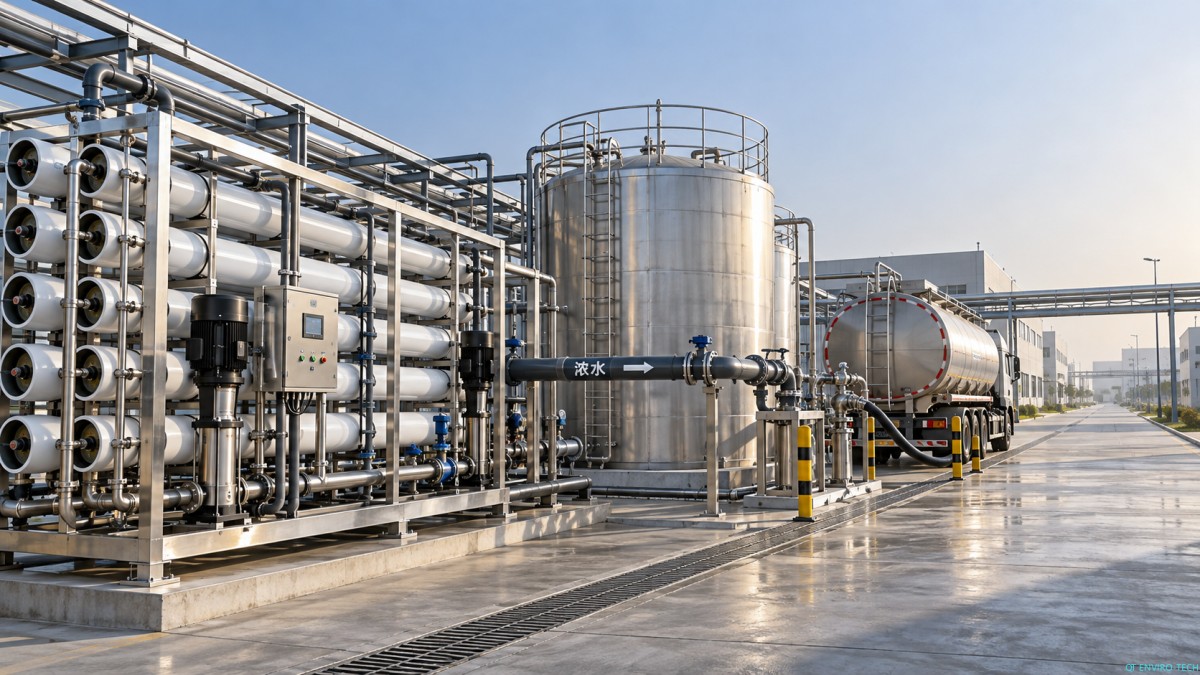
The decisive variable is often the disposal route available at the project site. Until that route has a credible permitting basis, confirmed capacity, and a defined cost structure, a lifecycle-cost estimate for Brackish Water RO Systems remains incomplete.
Recovery rate determines the volume that needs disposal
RO recovery is the percentage of feedwater converted into treated water. At a fixed treated-water output, higher recovery reduces both feedwater demand and concentrate volume:
Concentrate flow = treated-water flow × (1 ÷ recovery − 1)
For an illustrative system producing 100 m³/h, 75% recovery generates approximately 33.3 m³/h of concentrate. At 85% recovery, concentrate falls to approximately 17.6 m³/h. Over 8,000 operating hours, the difference is about 125,500 m³ annually.
At an assumed disposal charge of $2/m³, that reduction would save approximately $251,000 per year in volume-based disposal charges alone. These are hypothetical inputs, not market prices; actual charges depend on location, composition, transport, and acceptance conditions.
That saving is not automatically a justification for higher recovery. Assuming high salt rejection and no precipitation, the approximate concentration factor rises from four times the feedwater concentration at 75% recovery to 6.7 times at 85%. Higher salinity and scaling potential can require additional pressure, pretreatment, chemicals, or concentrate treatment. Reducing disposal volume does not eliminate the dissolved salt load.
The disposal route changes the investment boundary
A supplier’s quotation may end at the concentrate outlet. The project still needs a permitted destination and the infrastructure connecting it to that outlet.
No route should be treated as available solely because it appears technically possible. A nearby sewer does not establish permission to discharge saline concentrate. An evaporation pond requires a site-specific water balance, not simply a dry-climate assumption. Zero liquid discharge removes the liquid-discharge requirement but leaves solids requiring characterization and management.
Lower concentrate volume is not always lower total cost
The economic target is the lowest combined cost of water treatment and residual management, subject to reliable operation and compliance. It is not the highest achievable recovery.
Where disposal charges are volume-based, higher recovery has a measurable benefit. Where charges depend on salt loading or particular constituents, the saving can be smaller. A receiving facility may also reject a more concentrated stream even when its volume is lower.
Feedwater analysis therefore affects the financial comparison directly. Silica, hardness, sulfate, and other constituents can constrain recovery or require additional treatment. Proposals based only on total dissolved solids may conceal different assumptions about achievable performance.
Compare alternatives at the same net usable-water output, product-water quality, feedwater conditions, and annual operating hours. Include membrane cleaning waste, pretreatment sludge, and other residuals where applicable. Otherwise, a proposal can appear cheaper by excluding streams that still carry a disposal obligation.
Build the approval case around delivered water cost
A useful comparison is the present value of all project costs divided by the present value of usable water delivered. Costs should include installed RO equipment, concentrate infrastructure, permitting and development work, energy, chemicals, membrane replacement, disposal, monitoring, and applicable closure obligations.
For a renewable-energy facility, concentrate storage and disposal availability also affect water-supply resilience. If a receiving facility stops accepting deliveries, RO operation may have to stop when storage is full. The financial exposure can therefore include backup water purchases or interrupted production, not just higher disposal expenditure.
Before approval, the estimate needs a defensible concentrate flow and composition range, written receiving-facility acceptance conditions or a documented permitting pathway, and a clear allocation of infrastructure responsibilities. Disposal quotations should distinguish fixed charges, volume charges, transport costs, and composition-related surcharges.
Sensitivity testing should focus on the variables capable of changing the decision: achievable recovery, disposal tariffs, energy consumption, operating hours, and the cost of a backup route. Where disposal authorization remains unresolved, the investment case should show the fallback cost explicitly. An inexpensive RO package is not a low-cost water supply if its concentrate has nowhere affordable and lawful to go.
Recommendation
- Another Milestone Achieved! | Factory Testing Successfully Completed
- How brine disposal affects the cost of brackish water RO systems
- What Are Brackish Water RO Systems Used for at Industrial Sites?
- Empowering Sustainable Water Use Globally
- What Drives the Total Cost of Containerized Desalination Systems Over Their Life?
- RO Skid Acceptance Testing: Verifying Flow, Salt Rejection, and Energy Use
- Wastewater Treatment Training Delegation from Costa Rica Visits QT ENVIRO-TECH
- How to calculate brine flow from a containerized desalination system
- QT ENVIRO-TECH Wins 250 m³/day Seawater Desalination Project on Gorée Island, Senegal
- Designing Emergency Water Supply Systems for Remote Sites With Unreliable Grid Power