
Brackish Water RO Systems are used at industrial sites to reduce dissolved salts in groundwater or other moderately saline supplies. Their main applications include cooling tower makeup, boiler feedwater pretreatment, process water, and water preparation for hydrogen production. Without suitable treatment, these salts can contribute to scaling, corrosion, product contamination, or excessive equipment maintenance.
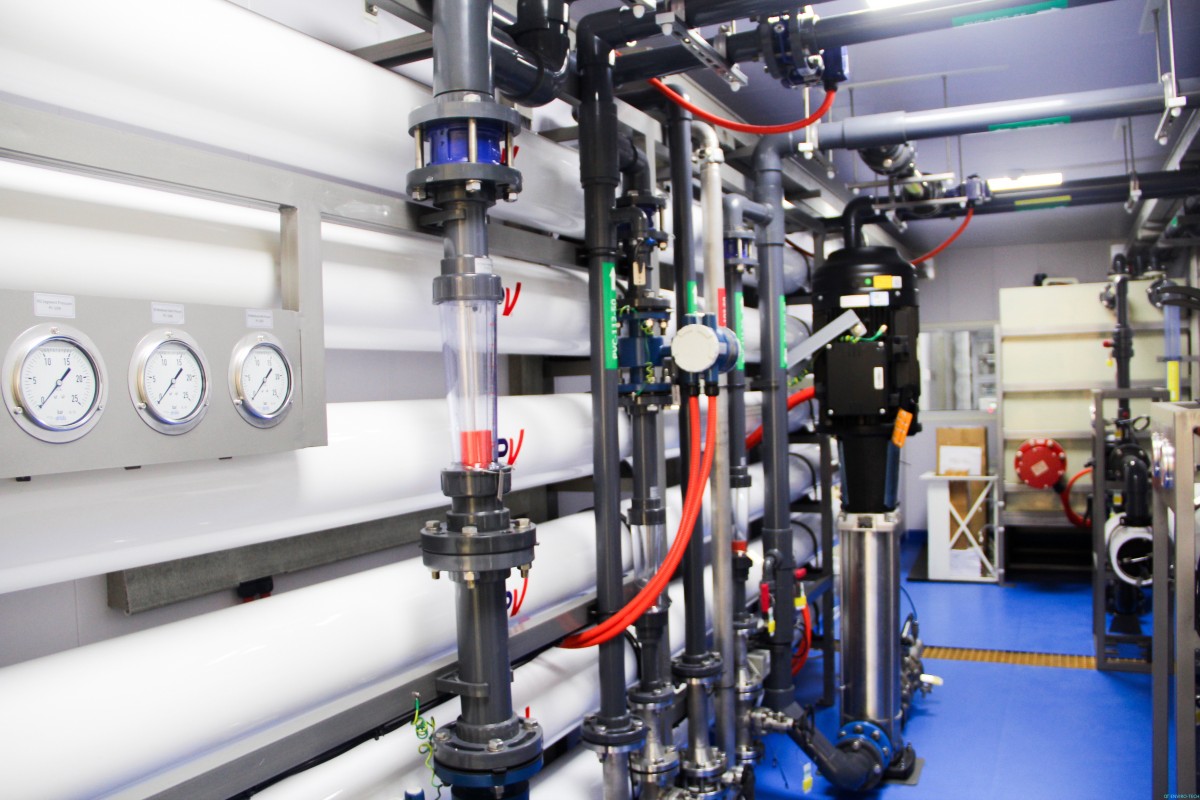
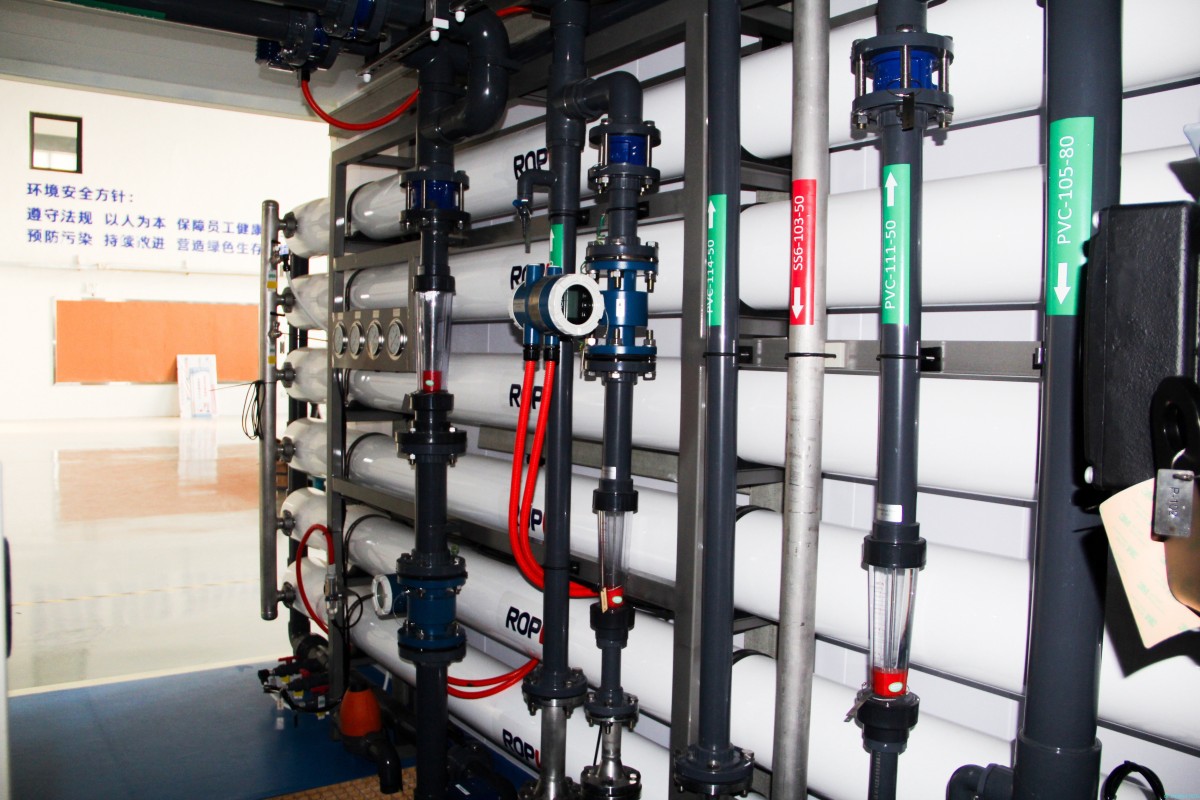
Reverse osmosis pushes water through membranes, producing a lower-salinity stream called permeate and a concentrated reject stream. The important distinction is that RO prepares water for a defined use; it does not automatically make water suitable for every industrial application. Some uses need additional purification, while others may only require partial desalination or blending.
Cooling tower makeup: controlling salt buildup
Cooling towers lose water through evaporation, leaving dissolved minerals behind. When brackish water supplies the tower directly, salts can accumulate quickly, increasing scale potential and requiring more blowdown to control circulating-water chemistry.
RO-treated makeup can reduce the incoming salt load and may allow higher cycles of concentration. However, the operating limit still depends on silica, hardness, alkalinity, chlorides, and the tower’s materials. Biological control and corrosion treatment remain necessary; lower conductivity alone does not establish a complete cooling-water treatment program.
Boiler feedwater needs more than desalination
At sites using steam for process heating or utility services, brackish water can introduce hardness and other dissolved constituents that cause deposits or impair steam quality. RO commonly serves as a pretreatment stage, reducing the mineral load before final feedwater conditioning.
The required treatment train depends on boiler pressure and the equipment supplier’s specifications. Higher-purity applications may need a second RO pass, electrodeionization, or ion exchange after the first pass. Dissolved gases also require separate control, such as deaeration. RO permeate should not be assumed ready for direct boiler use.
Process water and renewable energy applications
Industrial washing, rinsing, and solution preparation may need water with controlled conductivity or low concentrations of particular ions. Brackish-water RO can help where saline feedwater leaves deposits on surfaces, interferes with process chemistry, or introduces unwanted contaminants. The acceptance criteria should come from the process itself, rather than a generic “purified water” designation.
At renewable hydrogen facilities, RO can provide an initial desalination stage for electrolyzer water preparation. Electrolyzers typically require further purification to meet manufacturer limits for conductivity and specific impurities. Depending on feedwater quality and electrolyzer technology, this may involve additional RO treatment and polishing.
Hydrogen production also has separate water demands for cooling and auxiliary services. These streams may have different quality requirements, so treating all site water to electrolyzer-grade purity can add unnecessary cost and complexity.
When is brackish-water RO a suitable choice?
A site with saline groundwater should begin with a representative water analysis and the requirements of each intended use. Conductivity or total dissolved solids provides an initial indication of salinity, but neither reveals the full treatment challenge.
Scale-forming constituents: Calcium, sulfate, silica, and alkalinity influence recovery limits and scale-control measures.
Fouling risks: Suspended solids, iron, manganese, organic matter, and biological activity determine pretreatment needs.
Required output: Average demand, peak demand, and operating hours establish capacity and treated-water storage needs.
Concentrate management: The site needs a feasible, permitted route for the reject stream before system sizing is finalized.
Pretreatment may include filtration, iron removal, antiscalant dosing, or pH adjustment, depending on the analysis. Oxidizing disinfectants may need removal before chlorine-sensitive membranes. Increasing recovery reduces concentrate volume but raises salt concentrations inside the system, potentially increasing scaling risk.
Not every mineral-related problem calls for RO. Softening may be sufficient when hardness is the main concern and dissolved salts are otherwise acceptable. Conversely, highly saline feedwater may require equipment designed for seawater service. Where only selected processes need desalinated water, a dedicated RO supply—or controlled blending with an appropriate source—can avoid treating the entire site flow unnecessarily.
Recommendation
- What Are Brackish Water RO Systems Used for at Industrial Sites?
- Empowering Sustainable Water Use Globally
- What Drives the Total Cost of Containerized Desalination Systems Over Their Life?
- RO Skid Acceptance Testing: Verifying Flow, Salt Rejection, and Energy Use
- Wastewater Treatment Training Delegation from Costa Rica Visits QT ENVIRO-TECH
- How to calculate brine flow from a containerized desalination system
- QT ENVIRO-TECH Wins 250 m³/day Seawater Desalination Project on Gorée Island, Senegal
- Designing Emergency Water Supply Systems for Remote Sites With Unreliable Grid Power
- Happy National Day from QT ENVIRO-TECH
- How Do I Compare Containerized Desalination Suppliers?