
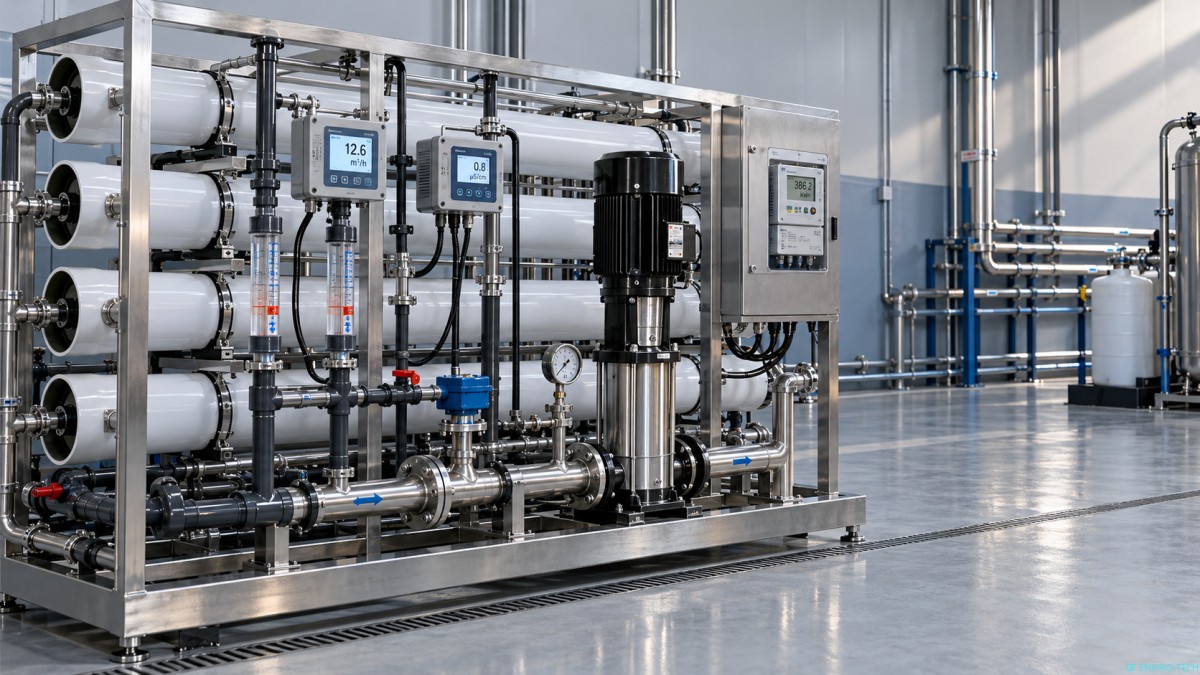
Accepting an RO skid requires more than confirming that water flows. For teams evaluating Skid Mounted RO Systems, acceptance testing should verify permeate flow, salt rejection, and specific energy consumption under agreed operating conditions. Pressure limits, alarms, and protective interlocks need separate checks. At renewable energy facilities, where treated water may support electrolyzer makeup or cooling, these records establish a defensible baseline—not merely a commissioning sign-off.
Agree on the test conditions before running the skid
A performance guarantee is incomplete without its reference conditions. The acceptance procedure should identify feedwater composition, temperature, inlet pressure, recovery, permeate backpressure, and the electrical measurement boundary. Define permitted deviations, stabilization criteria, test duration, and instrument accuracy before testing. Otherwise, a disagreement about “low output” may actually be a disagreement about the test basis.
Factory acceptance testing can confirm assembly, controls, and hydraulic operation, but factory water may not represent the site supply. Where salinity or pretreatment differs materially, document what the factory test demonstrates and reserve feed-dependent performance verification for site acceptance. Apply contractual requirements and relevant local safety rules; do not assume a universal pass threshold.
Read flow and rejection together
Measure feed, permeate, and concentrate flows after operation stabilizes. Check the water balance, allowing for sampling, flushing, or other documented streams. Calculate recovery as permeate flow divided by feed flow. A skid delivering its rated output at an unapproved recovery has not demonstrated the agreed duty.
Temperature matters: colder feed generally reduces membrane water permeability. Compare measured performance with the supplier’s agreed normalization method or membrane manufacturer’s calculation procedure. Keep both raw readings and normalized results; normalization should explain operating differences, not conceal excessive pressure or unsuitable feedwater.
Calculate salt rejection as [1 − (permeate salt concentration ÷ feed salt concentration)] × 100%, using paired samples and consistent analytical methods. Temperature-compensated conductivity is useful for operational checks, but conductivity-based rejection is a proxy and should not be treated as an exact concentration result without a validated relationship.
High rejection alone does not establish usable product water. Verify the absolute permeate quality against downstream requirements. Electrolyzer makeup, for example, may require further polishing and equipment-specific impurity limits beyond the RO guarantee.
Measure energy at a clearly defined boundary
Specific energy consumption is electrical energy consumed, in kWh, divided by permeate produced, in m³, over the same test interval. Use measured electrical input rather than motor nameplate power. State whether the figure covers only the high-pressure pump or also feed pumps, pretreatment, controls, and other auxiliaries.
Compare energy results only at comparable salinity, temperature, recovery, and product quality. For seawater systems with energy recovery devices, verify their operating conditions too. A lower energy reading achieved by reducing output or relaxing water quality is not an efficiency improvement at the contracted duty.
Treat protection checks as independent acceptance items
Verify applicable low-suction-pressure trips, high-pressure shutdowns, tank-level permissives, emergency stops, and off-spec permeate diversion. Use an approved simulation procedure rather than creating hazardous conditions. Confirm alarm indication, equipment response, reset logic, and restart behavior. For variable-power renewable installations, any automatic restart sequence needs explicit review.
Handover should include calibrated-instrument records, feed analysis, operating trends, laboratory results, control-test evidence, and unresolved deviations with assigned corrective actions.
QT ENVIRO-TECH provides seawater RO, brackish water RO, and wastewater treatment solutions, with RO capacities from 5 m³/h to 1,000 m³/h in containerized or skid-mounted configurations, including standardized and customized medium-scale options. For any configuration, agree the acceptance boundary early: the supplied skid’s verified performance and the complete treatment train’s downstream suitability are related, but separate, responsibilities.
Recommendation
- RO Skid Acceptance Testing: Verifying Flow, Salt Rejection, and Energy Use
- Wastewater Treatment Training Delegation from Costa Rica Visits QT ENVIRO-TECH
- How to calculate brine flow from a containerized desalination system
- QT ENVIRO-TECH Wins 250 m³/day Seawater Desalination Project on Gorée Island, Senegal
- Designing Emergency Water Supply Systems for Remote Sites With Unreliable Grid Power
- Happy National Day from QT ENVIRO-TECH
- How Do I Compare Containerized Desalination Suppliers?
- QT Enviro-Tech BWRO600 Brackish Water RO System Ships to Australia
- What Site Conditions Determine Coastal Desalination Reliability?
- Developing Countries Training Program Visits QT ENVIRO-TECH