
Battery plants use water throughout production, from electrode manufacturing to equipment cleaning, generating wastewater that may contain metals, salts, solvents, and other contaminants.
Industrial Wastewater Treatment Systems help manage these streams through processes such as chemical treatment, filtration, and, where appropriate, reverse osmosis.
Understanding how these stages work together is essential for evaluating discharge compliance and water reuse opportunities. This article explains the main treatment steps and the factors that influence system design in battery manufacturing facilities.
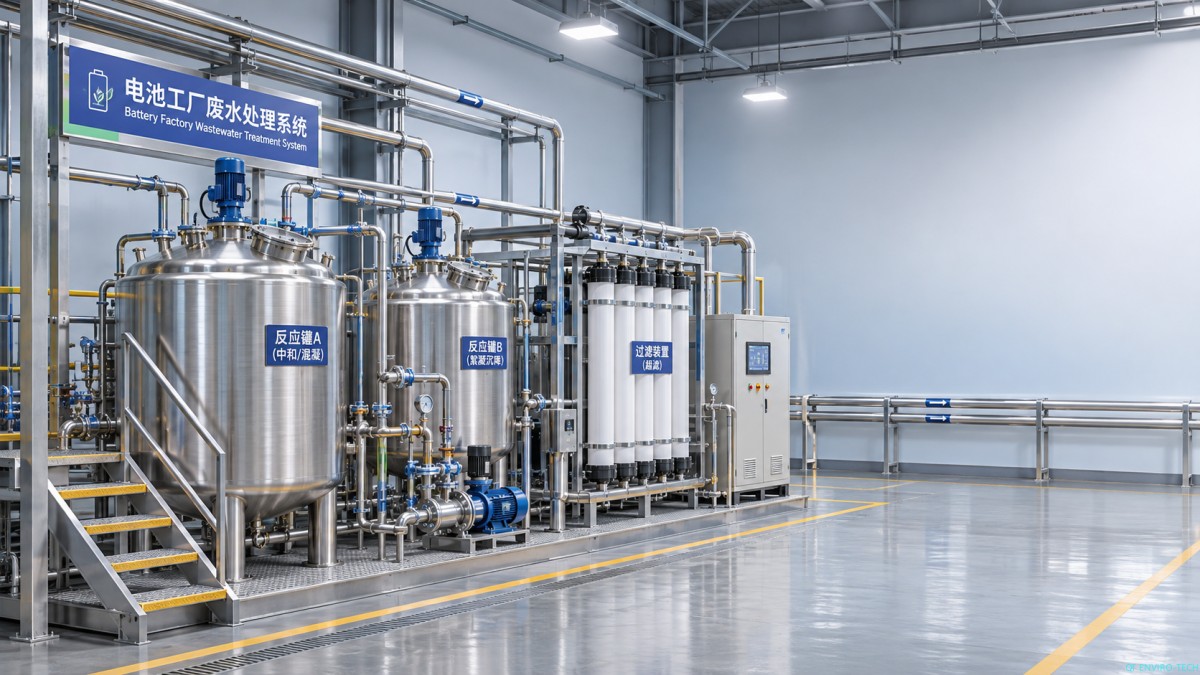
In practice, treatment works by separating incompatible wastewater streams, removing contaminants in stages, and checking whether the resulting water meets the requirements for discharge or reuse.
There is no single process suitable for every battery plant. The right configuration depends on battery chemistry, manufacturing activities, local discharge limits, and the intended use of treated water.
What contaminants are found in battery plant wastewater?
Wastewater composition varies across cell manufacturing, battery material production, and recycling. Even within one facility, different production lines can generate streams with very different treatment needs.
Depending on the operation, wastewater may contain lithium, nickel, cobalt, manganese, copper, or aluminum. Metals can originate from material handling, equipment cleaning, and other processes.
Other potential contaminants include suspended solids, salts, fluoride, organic compounds, and solvents. Cleaning chemicals can also cause sharp changes in acidity or alkalinity.
Some facilities use N-methyl-2-pyrrolidone, or NMP, in electrode production. Any solvent-containing stream requires separate characterization because conventional metal removal may not adequately address dissolved organic compounds.
These contaminants do not necessarily appear together. Sampling each source is the first step toward deciding which streams can be treated together and which need dedicated handling.
How does a wastewater treatment system work?
A typical system combines several treatment stages. Each stage prepares water for the next, while the exact sequence depends on the contaminants and treatment target.
1. Collect, separate, and balance wastewater
Operators identify wastewater sources and separate streams that could interfere with one another. Concentrated metal-bearing wastewater, solvent-rich liquids, and relatively clean rinse water may need different routes.
Equalization tanks then balance variations in flow and composition. More consistent water quality helps downstream equipment operate reliably and makes chemical dosing easier to control.
2. Adjust pH and remove dissolved metals
Chemical treatment commonly adjusts pH to convert certain dissolved metals into insoluble particles. The suitable pH and chemicals depend on the metals present and their concentrations.
Coagulation and flocculation can help these particles combine into larger clumps. Clarification or other solids separation equipment then removes much of the resulting material from the water.
Metal removal is not equally effective for every element under the same conditions. Treatability testing helps determine whether multiple treatment steps or additional polishing are needed.
3. Filter remaining solids and address other contaminants
Media filters or membrane filtration can remove finer suspended particles that remain after clarification. This protects downstream equipment and improves the consistency of treated water.
Depending on the wastewater, additional processes may be needed for fluoride, dissolved organics, or other contaminants. Options can include targeted chemical treatment, activated carbon, or biological treatment.
Each option has limits. For example, biological treatment depends on whether the organic compounds are biodegradable and whether metals or other substances inhibit the microorganisms.
4. Polish water for discharge or reuse
For discharge, the final treatment stages are selected to meet applicable permit limits. These may differ for direct discharge to surface water and discharge to a municipal sewer.
For reuse, filtration may be followed by reverse osmosis, which removes many dissolved salts and other dissolved contaminants. Adequate pretreatment is essential to reduce membrane fouling and scaling.
Reverse osmosis also produces a concentrated reject stream that requires management. Its suitability depends on water quality, reuse requirements, operating costs, and available concentrate disposal options.
Can treated wastewater be reused in a battery plant?
Yes, some treated wastewater can be reused when its quality matches the intended application. Potential uses include cooling tower makeup, utility washing, and selected cleaning operations.
More demanding applications may require additional polishing and consistent monitoring. Water used in production must meet the plant’s specifications, including any limits related to product quality.
Reuse can reduce freshwater purchases and wastewater discharge volumes, but the savings depend on local water prices, treatment costs, water recovery rates, and concentrate management.
A practical assessment compares those costs with the volume of water that can actually be reused throughout the year, including periods when production demand changes.
What happens to the waste removed during treatment?
Removing contaminants from water transfers some of them into sludge, spent media, or membrane concentrate. These residuals need storage, characterization, and an appropriate disposal or recovery route.
Chemical precipitation can generate metal-containing sludge that is thickened and dewatered before off-site management. Its classification and handling requirements depend on its composition and local regulations.
Where technically and economically feasible, separate collection of concentrated streams may support material recovery. The value depends on metal concentration, impurities, available processors, and transport costs.
What should facilities check before selecting a system?
Start with representative wastewater samples and flow measurements, including production peaks, cleaning cycles, and planned expansion. Average values alone can miss conditions that disrupt treatment.
Next, define the discharge permit requirements or reuse specifications. These targets determine how much treatment is needed and whether technologies such as reverse osmosis are justified.
Ask suppliers to explain expected performance, chemical consumption, sludge production, maintenance needs, and how the system will handle changes in wastewater composition or flow.
Bench or pilot testing can reduce uncertainty for complex streams. It is particularly useful when mixed contaminants, stringent limits, or high reuse targets make performance difficult to predict.
Space, installation time, and operator capability matter. QT ENVIRO-TECH offers standardized and customized water and wastewater treatment solutions in containerized or skid-mounted designs, with capacities from 5 to 1,000 m³/h.
How should a battery plant approach treatment planning?
Effective treatment starts with knowing what enters the system and where the treated water will go. Source separation, targeted contaminant removal, and appropriate monitoring connect those decisions.
By comparing tested treatment options against discharge limits, reuse needs, and full operating costs, facilities can select a system suited to their production conditions.
Recommendation
- How do wastewater treatment systems work in battery plants?
- Inside QT ENVIRO-TECH: Building a Global Presence in Water Treatment
- Brackish Water RO for Drinking Water: Key Standards and Testing
- Morocco Nador Seawater Desalination Project: Expanding Freshwater Resources Through RO Technology
- Can a skid-mounted RO system supply water at a remote solar farm?
- Mobile Sea Water Reverse Osmosis (SWRO) Treatment Plant: Flexible Desalination Solutions for Reliable Freshwater Supply
- How do seawater reverse osmosis systems produce fresh water?
- QT ENVIRO-TECH and Suzhou University of Science and Technology Sign Strategic Cooperation Agreement and Establish International Student Training Base
- What affects sludge production in battery wastewater treatment?
- Save 50% on Construction Time! The Containerized fastRO-BWC Brackish Water Desalination System – Plug and Play!