
Seawater reverse osmosis systems produce fresh water by applying pressure to seawater and forcing part of it through a membrane that rejects most dissolved salts. The water that passes through is collected as permeate, while the remaining stream carries away concentrated salts and other rejected substances.
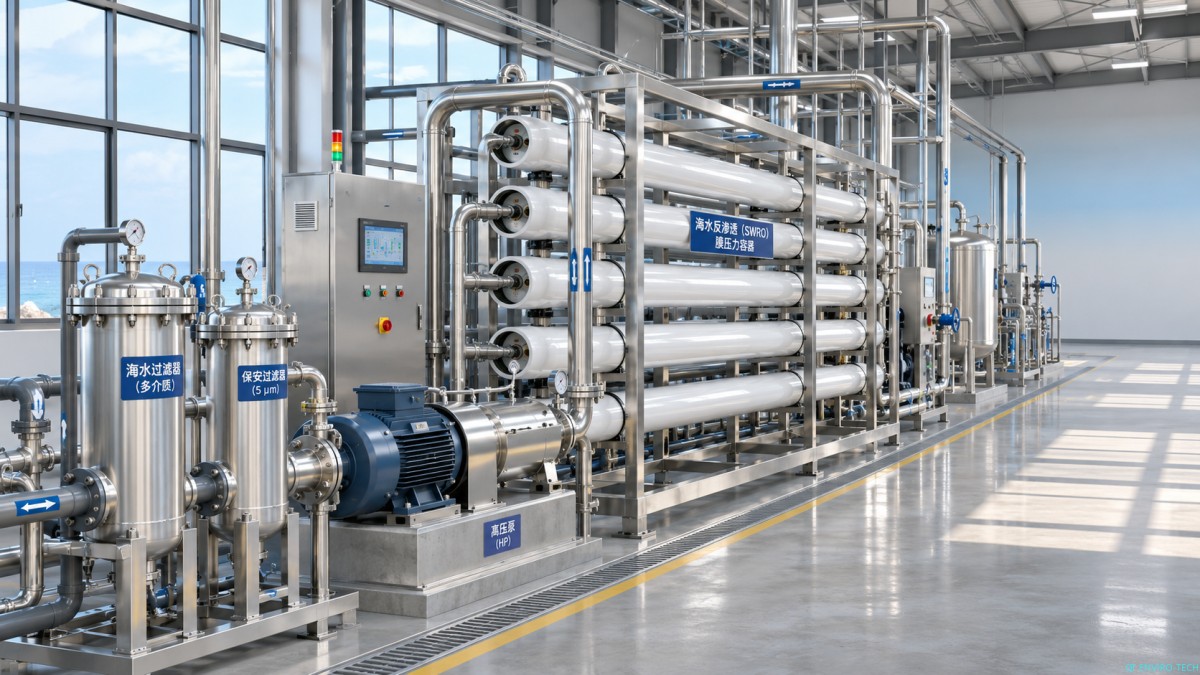
For a coastal facility relying on desalination, the membrane is only one part of the process. Seawater can contain sediment, algae and microorganisms that foul its surface, while the fresh water produced may need further treatment before use. A complete system therefore prepares the incoming water, separates it under pressure and adjusts the product water to suit its intended purpose.
From seawater intake to the membrane
Water first enters through an intake. Its quality can change with tides, weather and biological activity, so the treatment process must account for more than salt concentration. Suspended particles, organic matter and marine organisms can obstruct equipment or form deposits on membranes.
Pretreatment reduces these risks. Depending on the source water, it may include screening, media filtration or ultrafiltration, followed by cartridge filters that capture remaining particles before the high-pressure stage. Chemical treatment may also be used to control fouling or mineral scaling. Any disinfectant used upstream must be compatible with the membrane; some membrane materials are sensitive to oxidants such as chlorine and require their removal before the water reaches them.
Pretreatment does not remove all dissolved salt. Its main job is to protect downstream equipment and keep the feed water suitable for membrane separation.
Pressure drives the separation
In natural osmosis, water moves across a semipermeable membrane toward the more concentrated solution. Reverse osmosis works in the opposite direction: a pump raises the seawater pressure above its osmotic pressure, driving water through the membrane toward the lower-salt side.
The membrane is selective rather than a perfect barrier. It allows much of the water through while rejecting most dissolved salts and many other substances. Some dissolved material can still pass, so permeate quality depends on membrane condition, feed-water composition and operating conditions.
Not all incoming seawater becomes fresh water. The portion that does not pass through the membrane leaves as concentrate, often called brine. The fraction converted to permeate is known as the recovery rate. Raising recovery leaves less water to carry away the rejected salts, increasing concentration and the risk of scaling. The operating recovery must therefore reflect the feed-water chemistry and system design.
Making the permeate fit for use
Freshly produced permeate has a low mineral content and may be unsuitable for direct distribution without adjustment. Post-treatment can add minerals and adjust pH to improve stability and reduce the risk of corrosion in pipes and storage equipment. Disinfection may also be required where water will be stored or distributed for drinking.
For industrial uses, the required treatment depends on the process. Some applications may need additional purification; others may accept a different mineral balance. Conductivity is commonly monitored as an indication of dissolved salts, but it does not establish that water is safe to drink. Drinking-water use requires testing and treatment against the applicable local requirements.
Brine and energy: two parts of the same process
Brine contains the salts rejected by the membranes along with other constituents present in the feed and potentially treatment chemicals. It cannot simply be treated as ordinary fresh-water discharge. A disposal plan must consider local requirements, the receiving environment and how the concentrate will be dispersed or otherwise managed.
High-pressure pumping is a major energy demand. More saline or colder feed water, membrane fouling and operating pressure can affect the energy needed to produce a given amount of permeate. Many seawater RO systems use an energy-recovery device to transfer pressure from the outgoing concentrate stream to incoming feed water, reducing the load on the high-pressure pump.
What operators watch for
A change in performance can point to a problem before production stops. Operators commonly track feed and permeate flow, pressure, temperature and permeate conductivity. A rising pressure difference across a membrane stage can indicate fouling or blockage; increasing permeate conductivity can signal reduced salt rejection or a leak in a seal. Neither observation identifies the cause on its own, so readings should be assessed alongside feed-water conditions and pretreatment performance.
Membrane cleaning may restore performance when deposits are the cause, but cleaning chemicals and procedures must match the membrane and the type of fouling. Persistent changes in water quality, pressure or flow require investigation rather than simply increasing pump pressure, which can place additional stress on the system.
Recommendation
- How do seawater reverse osmosis systems produce fresh water?
- QT ENVIRO-TECH and Suzhou University of Science and Technology Sign Strategic Cooperation Agreement and Establish International Student Training Base
- What affects sludge production in battery wastewater treatment?
- Save 50% on Construction Time! The Containerized fastRO-BWC Brackish Water Desalination System – Plug and Play!
- Another Milestone Achieved! | Factory Testing Successfully Completed
- How brine disposal affects the cost of brackish water RO systems
- What Are Brackish Water RO Systems Used for at Industrial Sites?
- Empowering Sustainable Water Use Globally
- What Drives the Total Cost of Containerized Desalination Systems Over Their Life?
- RO Skid Acceptance Testing: Verifying Flow, Salt Rejection, and Energy Use