
Yes. A skid-mounted reverse osmosis (RO) system can supply water at a remote solar farm if the source is suitable, sufficient power is available, and the project has a workable plan for concentrate disposal and routine maintenance. The skid itself is only part of the solution: intake, pretreatment, storage, electrical supply and environmental protection must also be designed for the site.
RO can treat brackish groundwater or seawater for panel cleaning and other site uses, but the required water quality and volume should be established before selecting equipment. A system sized only around a nominal flow rate may struggle to meet a short, intensive cleaning campaign or produce water at the quality needed for the intended use.
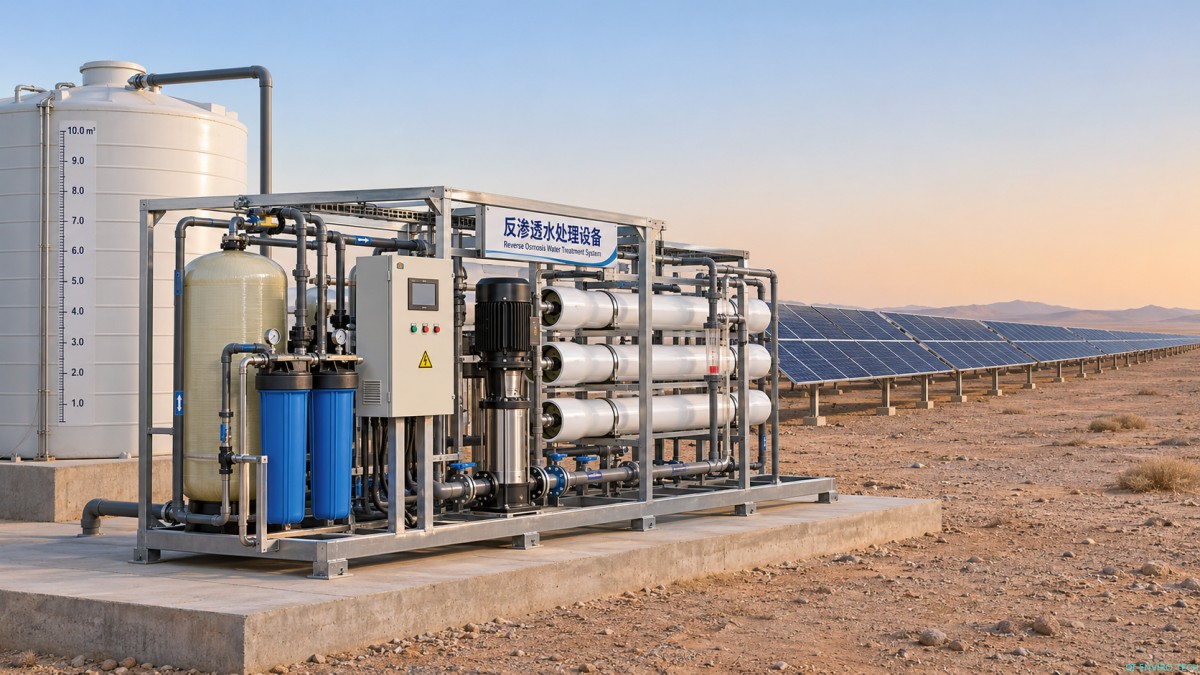
Start with the water source and its limits
A representative water analysis is the basis for determining whether RO is practical and what pretreatment it needs. Salinity influences membrane selection, operating pressure and energy demand; seawater generally requires a different pressure rating and more energy than brackish water. Suspended solids, hardness, iron, manganese, silica and biological contamination can also affect pretreatment and membrane performance.
Source availability matters as much as chemistry. A well must be able to sustain the required withdrawal without compromising its operation or breaching local water-use conditions. Surface water or seawater may require an intake arrangement and more extensive protection against suspended matter and biological fouling. Where source quality changes seasonally, a single sample may not capture the conditions the plant must handle.
RO does not convert all feedwater into usable product. The remainder leaves as a concentrated stream containing rejected salts and other constituents. The recovery rate must be designed around feedwater chemistry and the risk of scaling; it should not be assumed from an equipment brochure.
Match production to the cleaning schedule
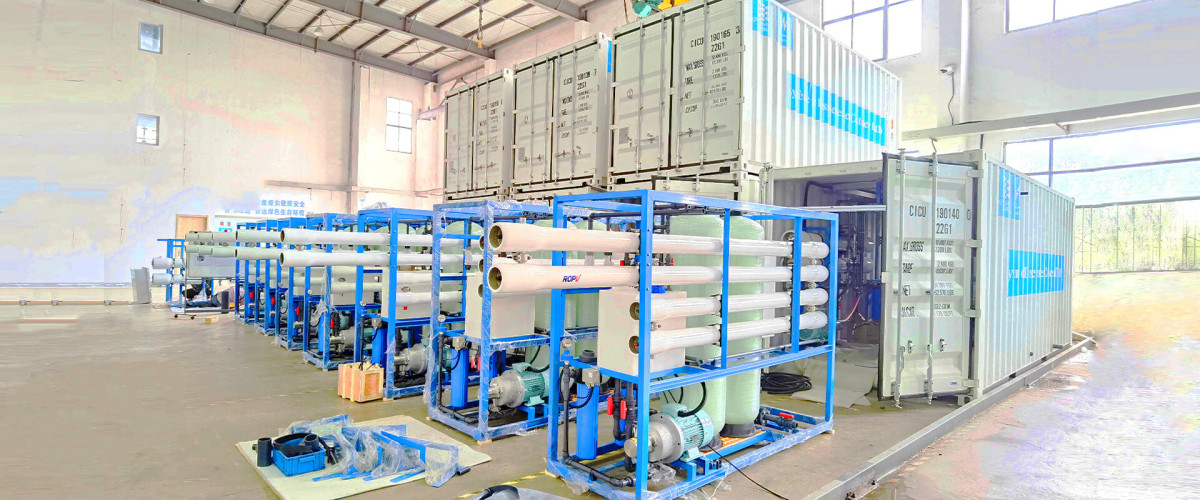
Solar-panel washing can create a demand pattern very different from the daily average. A farm may use relatively little water between cleaning events, then need a large volume over a short period. Product-water storage can allow a smaller RO unit to run over a longer period and build inventory before cleaning starts.
For example, if a planned wash requires 60 m³ and the treatment plant has six days to replenish the tank, it must produce at least 10 m³ per day for that purpose alone. The operating schedule must also allow for other site demand, maintenance, downtime and any reserve. If the plant can run only during a limited solar-powered window, its required hourly output will be higher than a calculation based on continuous operation.
Water quality should be defined by the cleaning method and equipment requirements. Residual dissolved solids can leave deposits as water evaporates, so a project should confirm the allowable conductivity or other quality limits with the relevant panel and cleaning-equipment specifications. Drinking water, if required, is a separate design case: RO permeate may need additional treatment, disinfection and monitoring to meet applicable local requirements.
Plan for power interruptions and remote operation
A solar farm does not automatically have power available whenever the RO plant needs it. Treatment loads must be coordinated with the site’s electrical system, including voltage, starting loads and the availability of power outside generation hours. Batteries, a generator or grid supply may provide support, but the choice depends on the required operating schedule and the wider site design.
Frequent shutdowns should be considered during equipment selection. The control system may need provisions for safe shutdown, flushing and restart, while tanks provide a buffer between variable production and water demand. Remote monitoring can help identify abnormal pressures, declining flow or off-specification water, but it does not eliminate the need for local intervention.
Consumables and maintenance access should be included in the execution plan. Cartridge filters, treatment chemicals where required, instruments, membrane cleaning arrangements and replacement parts all need a supply route. An isolated skid with no practical provision for servicing can become an unreliable water source even when the initial design is sound.
A skid simplifies assembly, not site preparation
A skid-mounted RO system suitable for remote sites still needs a prepared installation area, connections and protection from local conditions. Transport dimensions and lifting capacity affect delivery; foundations or a stable level base, drainage, piping, electrical protection and safe maintenance clearance affect installation. Dust, heat, freezing temperatures or coastal corrosion may make a shelter or enclosed arrangement necessary.
Concentrate management can be the deciding constraint. Options depend on the location and water chemistry and may include an authorized discharge route, evaporation facilities where appropriate, or off-site handling. Each option has land, transport, environmental and permitting implications. Sending concentrate back to the source or onto the ground should not be assumed acceptable.
The most useful early decision is therefore not simply whether RO fits on a skid, but whether the complete water balance works: a dependable source, enough treatment capacity during available operating hours, storage for peak cleaning demand, and an approved destination for concentrate. If any one of those elements is unresolved, transported water or another treatment approach should remain in the comparison.
Recommendation
- Can a skid-mounted RO system supply water at a remote solar farm?
- Mobile Sea Water Reverse Osmosis (SWRO) Treatment Plant: Flexible Desalination Solutions for Reliable Freshwater Supply
- How do seawater reverse osmosis systems produce fresh water?
- QT ENVIRO-TECH and Suzhou University of Science and Technology Sign Strategic Cooperation Agreement and Establish International Student Training Base
- What affects sludge production in battery wastewater treatment?
- Save 50% on Construction Time! The Containerized fastRO-BWC Brackish Water Desalination System – Plug and Play!
- Another Milestone Achieved! | Factory Testing Successfully Completed
- How brine disposal affects the cost of brackish water RO systems
- What Are Brackish Water RO Systems Used for at Industrial Sites?
- Empowering Sustainable Water Use Globally