
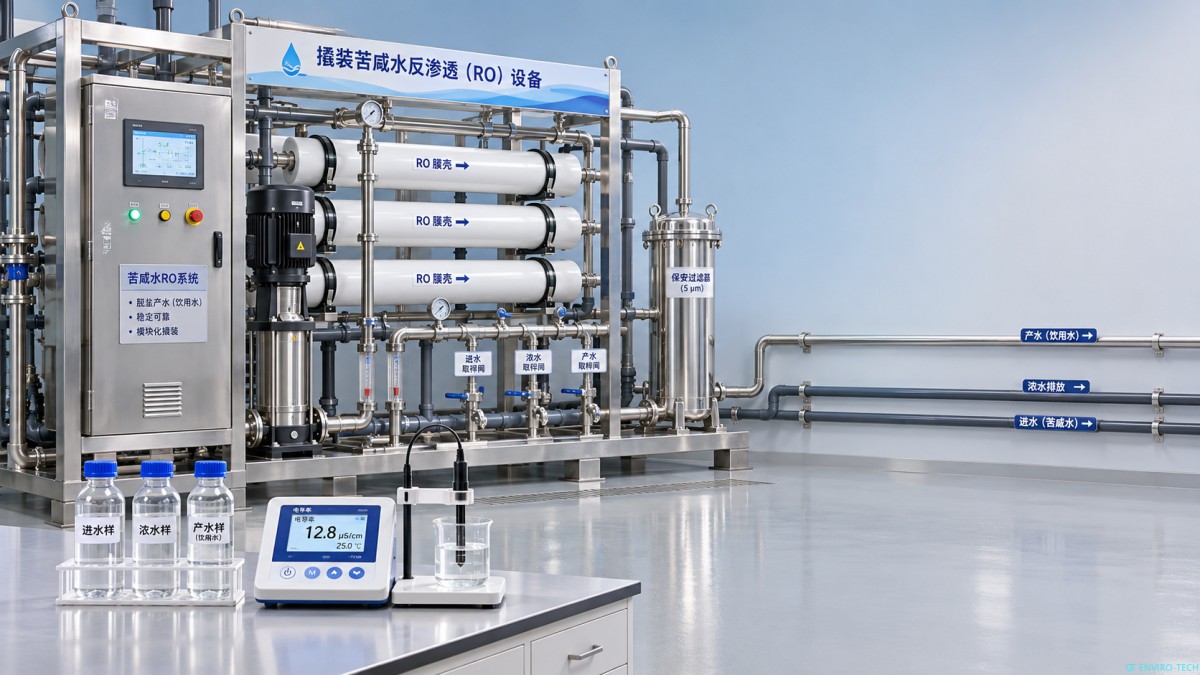
Brackish Water RO Systems can provide a reliable source of drinking water, but treatment performance alone does not guarantee water safety.
Quality control and safety managers must also consider applicable drinking water standards, source-water variability, and a consistent testing program.
From monitoring conductivity and salt rejection to verifying microbiological and chemical quality, the right checks help identify risks before treated water reaches users.
This guide explores the key standards and testing practices that support safe, dependable operation.
Which drinking water standards apply to your RO system?
Start with the legally enforceable drinking water requirements at the point of use. These may depend on the country, local authority, and intended supply.
The World Health Organization’s Guidelines for Drinking-water Quality provide an international reference, but their guideline values do not automatically replace national or local regulations.
In the United States, applicable EPA National Primary Drinking Water Regulations set enforceable limits for regulated contaminants in covered public water systems.
Secondary standards address characteristics such as taste, odor, and staining. They are generally non-enforceable federally, although individual states may adopt enforceable requirements.
Confirm which rules apply to your operation, including sampling locations, accredited laboratory methods, reporting obligations, and any requirements for storage and distribution.
Check product certifications separately. NSF/ANSI standards may address material safety or treatment performance, but certification alone does not prove that finished water meets every applicable limit.
What should you test before selecting a system?
A representative source-water analysis establishes both treatment needs and operating risks. Test during different seasons or operating conditions when salinity and groundwater quality may change.
Measure total dissolved solids, conductivity, pH, temperature, hardness, alkalinity, and turbidity. These results support membrane selection, recovery targets, and pretreatment design.
Analyze relevant ions, including chloride, sulfate, sodium, calcium, silica, iron, and manganese. Their concentrations influence corrosion, scaling, fouling, and finished-water acceptability.
Screen for health-related contaminants based on local risks, such as arsenic, fluoride, nitrate, boron, and naturally occurring radionuclides. Do not assume conductivity reveals their presence.
Assess microbiological quality and potential contamination sources, including agricultural runoff, nearby wastewater discharges, and compromised wells. Share the complete analysis with equipment suppliers.
Which operating checks reveal problems early?
Conductivity is a useful continuous indicator of dissolved salts, while pressure, flow, and temperature help operators assess membrane condition and overall system performance.
Compare feed and permeate conductivity under stable conditions. A rising permeate value or declining rejection can indicate membrane damage, seal leakage, or changing feed conditions.
Calculate approximate conductivity rejection as: (1 − permeate conductivity ÷ feed conductivity) × 100. Use consistent units and temperature compensation for meaningful comparisons.
This calculation is a screening tool, not a contaminant-specific removal guarantee. Individual substances can pass through membranes at different rates and require separate laboratory verification.
Track differential pressure across pretreatment and membrane stages, permeate flow, recovery, and normalized performance. Unexpected trends can signal fouling, scaling, or equipment problems.
Set site-specific alert and action limits using commissioning data, supplier guidance, and regulatory requirements. Record instrument calibration, maintenance, cleaning, and corrective actions.
How should finished drinking water be tested?
Test finished water after all treatment steps, including blending, remineralization, and disinfection. Also sample storage and distribution points where water quality can change.
Use qualified laboratories and approved methods where required. Include regulated chemical contaminants relevant to the source, treatment chemicals, and materials contacting the water.
Verify microbiological safety using the indicators and methods required by the local authority. For many drinking water programs, this includes testing for E. coli.
RO can provide a microbial barrier, but contamination can occur through damaged components, poorly maintained storage, or downstream piping. A disinfection strategy may therefore be necessary.
Monitor disinfectant residual where required or appropriate for the distribution system. Verify that the selected disinfectant and contact time achieve the intended protection.
Check pH, alkalinity, hardness, and corrosion indicators after remineralization. Very low-mineral water can be corrosive, potentially increasing metal release from downstream plumbing.
Where disinfection byproducts or metals are relevant, include them in the testing plan. Their risks depend on water chemistry, treatment, materials, and distribution conditions.
How often should your team sample?
Follow mandatory sampling frequencies first, then increase monitoring where source conditions, operational changes, or past results justify closer control. There is no universal schedule.
Continuous or frequent operational checks can cover conductivity, pressure, and flow. Microbiological and chemical sampling should follow a documented, risk-based schedule and regulatory requirements.
Collect additional samples after well maintenance, membrane replacement, disinfection failure, flooding, or an unexplained change in permeate quality. Define when normal sampling can resume.
Keep a sampling plan that identifies locations, parameters, methods, responsibilities, and response limits. Review trends regularly instead of treating each laboratory report in isolation.
What should happen when results exceed a limit?
Define escalation steps before a failure occurs. Depending on the risk and local requirements, isolate affected water, stop supply, and notify responsible authorities and users.
Investigate the cause using operating logs, instrument checks, inspection, and confirmatory sampling. Retest after corrective work and obtain any required approval before restoring service.
Document the incident, affected volumes, communications, and preventive measures. Review recurring deviations to determine whether pretreatment, maintenance, monitoring, or system design needs improvement.
Choosing a system that supports water safety
Ask suppliers to explain pretreatment, membrane selection, expected recovery, instrumentation, disinfection, and post-treatment using your actual feed-water analysis and finished-water objectives.
Request a commissioning and monitoring plan, including sampling points, acceptance criteria, maintenance requirements, and responsibilities. Confirm that performance claims specify their operating conditions.
QT ENVIRO-TECH offers standardized and customized brackish water RO solutions from 5 to 1,000 m³/h, with containerized or skid-mounted configurations for on-site installation.
Safe drinking water depends on more than membrane performance: applicable standards, representative testing, operational controls, and a clear response plan must work together throughout operation.
Recommendation
- Inside QT ENVIRO-TECH: Building a Global Presence in Water Treatment
- Brackish Water RO for Drinking Water: Key Standards and Testing
- Morocco Nador Seawater Desalination Project: Expanding Freshwater Resources Through RO Technology
- Can a skid-mounted RO system supply water at a remote solar farm?
- Mobile Sea Water Reverse Osmosis (SWRO) Treatment Plant: Flexible Desalination Solutions for Reliable Freshwater Supply
- How do seawater reverse osmosis systems produce fresh water?
- QT ENVIRO-TECH and Suzhou University of Science and Technology Sign Strategic Cooperation Agreement and Establish International Student Training Base
- What affects sludge production in battery wastewater treatment?
- Save 50% on Construction Time! The Containerized fastRO-BWC Brackish Water Desalination System – Plug and Play!
- Another Milestone Achieved! | Factory Testing Successfully Completed