
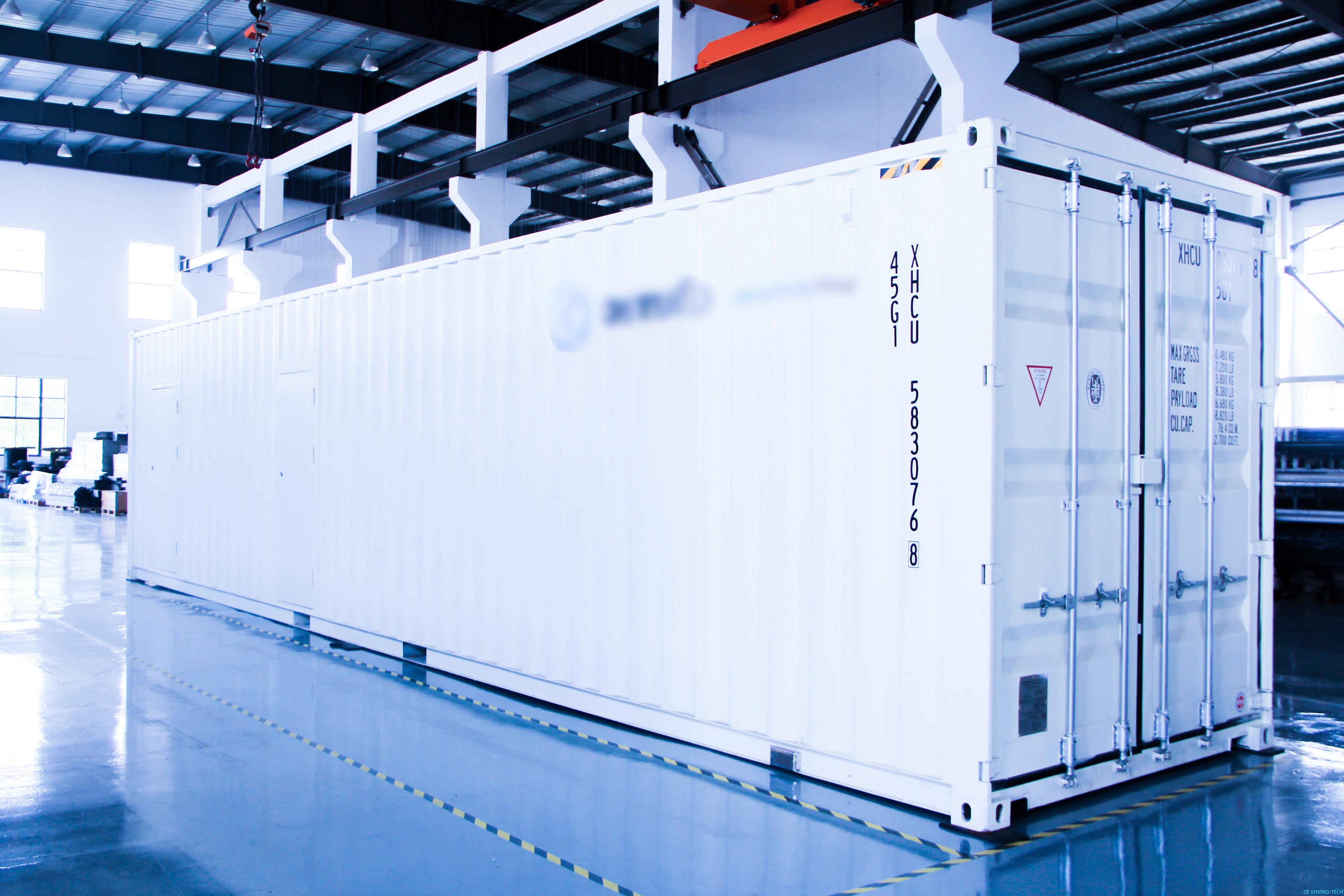
What Are Containerized Desalination Systems
Containerized Desalination Systems are factory-integrated water treatment plants installed inside, on, or alongside standardized transport containers or skid-mounted enclosures. They are designed to convert seawater or brackish groundwater into water suitable for industrial processes, utilities, irrigation support, construction activity, or other defined uses. The container format protects equipment, simplifies transport, reduces site assembly work, and creates a repeatable package for projects where civil construction time is limited.
A typical package includes feed-water pumping, pretreatment, reverse osmosis membranes, high-pressure pumping, flushing arrangements, instrumentation, electrical controls, and product-water transfer equipment. The exact scope depends on the feed-water analysis and target water quality. Seawater systems normally require higher operating pressure and more robust materials than brackish water systems because dissolved salt concentrations, corrosion exposure, and osmotic pressure are substantially higher.
The word containerized should not be treated as a guarantee of plug-and-play operation. Site connections, intake design, brine discharge, power availability, product-water storage, chemical handling, and local permits still determine whether a project performs reliably. For procurement, the practical definition is a modular desalination plant with a documented process boundary, clear utility requirements, transport dimensions, maintainable equipment access, and stated production conditions.
How Reverse Osmosis Desalination Works
Most modern Containerized Desalination Systems use reverse osmosis, commonly called RO. In RO, a high-pressure pump drives feed water across semi-permeable membrane elements. Water molecules pass through the membrane as permeate, while most dissolved salts, suspended contaminants, and other rejected constituents leave as concentrated brine. The process is physical separation rather than evaporation, which generally makes it more practical for decentralized and energy-conscious installations.
Pretreatment is essential because RO membranes are sensitive to fouling, scaling, biological growth, and oxidant damage. Depending on source-water conditions, pretreatment may include screening, multimedia filtration, cartridge filtration, ultrafiltration, antiscalant dosing, pH adjustment, dechlorination, or specialized iron and manganese removal. A supplier should base this train on representative raw-water data, including turbidity, silt density index, total dissolved solids, hardness, silica, organics, temperature, and microbiological risk.
After RO separation, product water may need remineralization, pH correction, disinfection, or blending before use. Drinking-water applications require quality criteria defined by the responsible local authority, while industrial applications may instead focus on conductivity, chloride, hardness, boron, silica, or other process-specific limits. Monitoring conductivity, pressure, flow, recovery, differential pressure, and chemical dosing enables operators to identify changing feed conditions before membrane performance or output is materially affected.
Main Types And Technology Configurations
Seawater reverse osmosis systems are intended for high-salinity sources, usually coastal seawater or saline industrial intakes. They require high-pressure pumps, pressure-rated piping, corrosion-resistant wetted components, and careful energy management. Energy recovery devices can reduce the energy consumed by transferring pressure from reject brine to incoming feed water. Their suitability depends on plant scale, operating hours, source salinity, maintenance capability, and the economics of energy savings over the project life.
Brackish water desalination systems are generally used for groundwater, inland wells, estuaries, or process streams with lower salinity than seawater. Their required pressure is usually lower, although challenging feed-water chemistry can make pretreatment more complex. High hardness, silica, barium, sulfate, iron, hydrogen sulfide, and seasonal variation may affect recovery targets and chemical consumption. A lower salt level does not automatically mean lower risk; the appropriate design depends on the complete feed-water profile.
Configurations also differ by mobility and redundancy. A compact single-container unit may suit temporary construction sites, emergency supply, remote camps, and pilot projects. Larger facilities can use several containers for pretreatment, RO trains, electrical equipment, chemicals, and controls. Parallel trains allow staged capacity expansion and maintenance flexibility. Buyers should distinguish nominal production capacity from guaranteed output under stated salinity, temperature, feed pressure, recovery, and membrane condition.
Who Uses These Systems And Where They Fit
Containerized Desalination Systems are relevant to industrial operators, municipal water providers, island facilities, ports, mining and construction projects, hotels, fisheries, agriculture-related operations, disaster-response organizations, and remote energy assets. They are especially useful when freshwater supply is constrained but saline or brackish water is available nearby. Their modularity can shorten deployment planning compared with a fully site-built plant, provided external infrastructure is prepared in parallel.
In the new energy sector, desalination may support workforce facilities, dust control, equipment washing, process-water preparation, and utility needs at sites located near coasts or in water-stressed regions. Water quality requirements should be tied to the actual end use. Treating all water to potable quality can increase energy and chemical consumption unnecessarily, while under-treating water can damage downstream equipment or create operational restrictions.
QTET can be considered for projects requiring seawater desalination equipment, brackish water desalination equipment, RO seawater desalination equipment, or complete water treatment equipment within an integrated project scope. A practical supplier discussion should establish feed-water conditions, required daily output, operating schedule, available utilities, discharge route, and target water specification before choosing the container layout. This approach helps align the package with the project rather than selecting solely from a nominal capacity label.
Selection Criteria And Market Access Considerations
The first selection criterion is water analysis. Procurement teams should request a recent laboratory report and consider seasonal or tidal variation where applicable. The report supports sizing for flux, recovery, pretreatment, chemical dosing, and cleaning frequency. It also enables bidders to explain assumptions transparently. A proposal that omits raw-water quality, operating temperature, and product-water targets cannot provide a meaningful basis for comparing performance, energy use, or membrane life.
The second criterion is site integration. Confirm the incoming electrical supply, voltage and frequency, generator compatibility, intake pumping distance, elevation changes, drainage, ventilation, lifting access, noise limits, climate exposure, and operator access. Containerized equipment still needs safe access for cartridge replacement, membrane loading, chemical delivery, inspection, and lifting. In hot, dusty, humid, or corrosive locations, enclosure ventilation and component material choices require particular attention.
Market access requirements depend on destination and application. Buyers should identify applicable local rules for water discharge, electrical safety, pressure systems, chemical storage, transport, drinking-water quality, and environmental approvals. Common industry references may be useful, but the relevant authority and project contract determine compliance. Documentation should clearly cover process flow, piping and instrumentation, electrical drawings, operating instructions, spare parts, commissioning checks, and water-quality sampling responsibilities.
Installation, Quality Control, And Maintenance
A successful installation begins with a defined battery limit. The site team should prepare foundations or level supports, raw-water connections, product-water routing, brine discharge, electrical supply, earthing, drainage, and safe chemical storage before delivery. The supplier and owner should agree on who provides cranes, lifting plans, pipework beyond the container, civil works, consumables, and initial operator support. Early responsibility mapping prevents commissioning delays caused by missing interfaces.
Quality control should cover incoming components, assembly inspection, pressure testing where appropriate, electrical checks, instrument verification, factory functional testing, and shipment protection. During commissioning, operators should record feed-water quality, flows, pressures, conductivity, recovery, and chemical settings as the initial operating baseline. For complete water treatment equipment, the control philosophy should also identify alarms, interlocks, emergency shutdown conditions, and procedures for flushing after a power interruption or planned stop.
Maintenance is condition-based as well as calendar-based. Cartridge filters are changed when differential pressure rises to the defined limit; membranes are cleaned when normalized permeate flow declines, salt passage rises, or differential pressure indicates fouling. Pumps, valves, sensors, dosing equipment, and electrical panels need scheduled inspection. Keeping trend records is more valuable than reacting only to alarms, because normalized performance data can reveal gradual scaling, fouling, or pump deterioration before output is lost.
Energy, Total Cost Of Ownership, And Future Trends
Energy is usually one of the largest operating costs for Containerized Desalination Systems, particularly for seawater RO. Consumption depends on salinity, temperature, recovery, membrane condition, pump efficiency, pressure-control design, pretreatment losses, and production pattern. Buyers should ask for estimated specific energy consumption under clearly defined water conditions, not a single unqualified figure. Operating intermittently may also increase flushing needs and complicate stable water quality, so duty cycle matters in energy planning.
Total cost of ownership includes capital equipment, freight, site preparation, power, chemicals, membrane replacement, consumable filters, labor, spare parts, maintenance, brine management, laboratory testing, and downtime risk. The lowest purchase price may not deliver the lowest lifecycle cost if it uses inefficient pumps, has limited access for service, lacks critical instrumentation, or requires frequent manual intervention. A useful comparison evaluates cost per cubic meter of compliant product water over the expected operating period.
Industry development is moving toward improved energy recovery, more efficient pumps and membranes, remote monitoring, predictive maintenance, modular capacity expansion, and greater compatibility with variable renewable power. These advances do not remove the need for sound intake, pretreatment, and discharge engineering. For a credible return-on-investment assessment, compare a QTET desalination solution with alternatives such as tanker delivery, groundwater development, centralized water connection, or production curtailment, using local water demand, logistics exposure, energy pricing, and regulatory obligations.